The hidden driver of chronic disease is not always found in hospitals or clinics, but in the ordinary moments that unfold between medical visits.
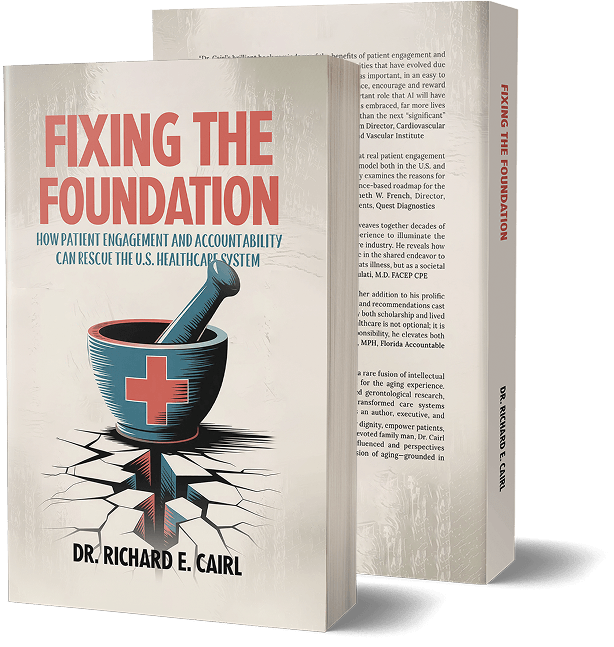
In “Fixing the Foundation,” Fixing the Foundation reframes America’s $4.9 trillion healthcare system crisis by arguing that outcomes are determined less by interventions and more by patient engagement and accountability.
According to Dr. Richard E. Cairl, the true burden of disease management lies in daily choices, from medication adherence and diet quality to movement patterns and early symptom recognition.
These seemingly small decisions accumulate into powerful trajectories of health or decline.
The book illustrates this through patient narratives that mirror two contrasting realities: one where patients are supported as active partners and another where disengagement leads to repeated hospitalizations and preventable complications.
In this framework, hospitals are not the primary drivers of health, but rather safety nets that intervene when upstream behaviors fail to sustain stability.
Between appointments, patients like Elena and Marcus demonstrate the divergence between engagement and neglect.
One follows structured care plans, uses digital tools and communicates proactively with providers, while the other cycles through crisis-driven encounters shaped by avoidable exacerbations.
The contrast reveals a central thesis: healthcare outcomes are co-produced, not merely delivered.
Without patient engagement and accountability, even the most advanced medical interventions lose effectiveness outside the clinical setting.
The book argues that closing this gap requires a redefinition of responsibility across the entire healthcare ecosystem.
This includes patients taking ownership of daily health behaviors, providers adopting partnership-based communication and policymakers embedding engagement metrics into reform frameworks.
It also highlights how artificial intelligence tools can support continuity between visits by offering real-time feedback and personalized nudges that reinforce adherence and early intervention.
In this sense, technology becomes an enabler of responsibility, not a substitute for it.
Ultimately, the book positions the kitchen, sidewalk, pharmacy and home environment as the true arenas of healthcare decision-making.
These everyday spaces determine whether chronic conditions stabilize or progress and whether healthcare systems operate sustainably or remain under strain.
As emphasized in Fixing the Foundation, transforming outcomes requires more than reform at the system level; it demands a cultural shift toward shared accountability.
The message is clear: fixing healthcare does not begin solely in Washington or in hospitals, but in the everyday actions of patients and the systems that support them.
Dr. Richard E. Cairl’s work invites readers to reconsider what it means to participate in healthcare, not as passive recipients, but as active co-creators of health itself.
In doing so, it reframes chronic disease not only as a clinical challenge but as a shared human responsibility that unfolds in the spaces between visits.
Ultimately, this perspective challenges readers to move beyond blame or complacency and toward partnership where every decision, every habit and every moment of follow-through shapes long-term health outcomes across populations.
This is the foundation that Dr. Richard E. Cairl calls for in Fixing the Foundation, a future where engagement, accountability and shared responsibility define sustainable healthcare reform in America, driven by patients and providers working together daily in practice and policy alike.