Few terms in healthcare generate as much discomfort as “patient responsibility.” For some, it sounds like a necessary correction to a system overwhelmed by chronic disease and preventable hospitalizations. For others, it feels like a thinly veiled way of blaming individuals for complex medical and social conditions. The result is a concept that is widely referenced, frequently avoided and deeply misunderstood.
In Fixing the Foundation, Dr. Richard E. Cairl argues that this confusion is one of the key reasons healthcare reform continues to struggle. The problem is not that patient responsibility is irrelevant, it is that it has never been properly defined, supported or integrated into the structure of care.
At its core, patient responsibility is often mischaracterized as a moral judgment about behavior. In reality, it is a functional requirement of healthcare itself. Medicine does not operate in isolation from daily life. Instead, health outcomes are continuously shaped by what happens outside clinical settings, what patients eat, whether they take medications as prescribed, how they respond to symptoms and whether they engage with care plans over time.
This means that healthcare is not simply delivered; it is co-produced.
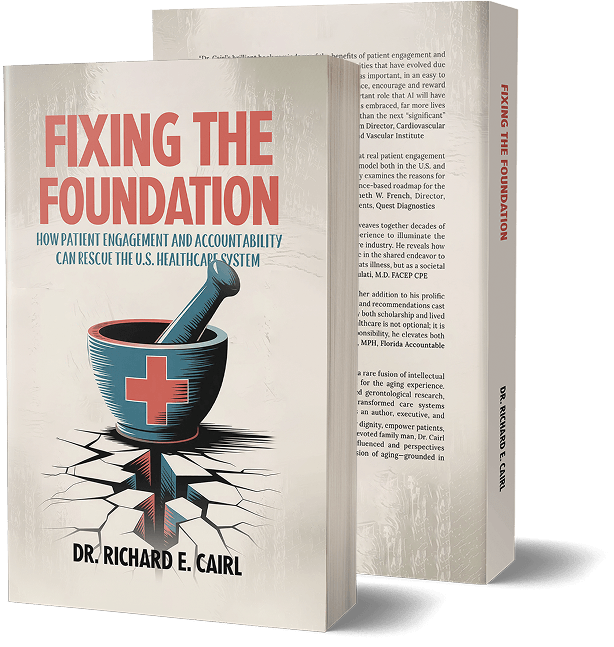
Dr. Cairl reframes patient responsibility as “accountable engagement,” a set of practical behaviors that determine whether medical care succeeds in the real world. These include asking questions, confirming understanding, disclosing barriers, following treatment plans, monitoring symptoms, recognizing warning signs, attending appointments and communicating openly when lapses occur.
Yet despite its importance, patient responsibility is often treated inconsistently within healthcare systems. Patients are instructed to follow care plans but are rarely supported in building the daily habits required to do so. They are expected to understand complex instructions, manage chronic conditions and navigate fragmented systems often without sufficient education, reinforcement or tools.
This gap leads to misunderstanding on both sides. Clinicians may interpret non-adherence as a lack of motivation. Patients may experience instructions as unrealistic or disconnected from their lived reality. Policymakers may overlook the behavioral foundation of chronic disease entirely, focusing instead on structural reforms alone.
Fixing the Foundation argues that this disconnect is not just a communication problem; it is a design flaw. Patient responsibility cannot function as a vague expectation; it must be operationalized within a supportive system. Engagement must be made measurable, teachable and sustainable. Accountability must be paired with access, clarity and trust.
Importantly, Dr. Cairl is explicit that patient responsibility is not synonymous with blame. Many patients face significant barriers, including limited health literacy, financial constraints, cultural and language differences, mental health challenges and systemic inequities. These realities shape behavior in profound ways. A fair model of responsibility must therefore include reciprocal responsibility from healthcare systems and providers.
That means clinicians must communicate clearly, use plain language and create space for questions. Systems must reduce friction, improve continuity and make care easier to navigate. Technology, including AI-driven tools, must support patients in real time, helping translate instructions into daily actions and providing feedback between visits.
When properly understood, patient responsibility is not a burden placed on individuals; it is a shared structure that enables better outcomes for everyone. It transforms healthcare from a series of isolated interventions into a continuous partnership.
The misunderstanding arises when responsibility is treated as optional, moralized or one-sided. Dr. Cairl’s work challenges that framing directly. In his view, healthcare cannot achieve its goals if it ignores the daily reality of patient behavior. The success of any treatment ultimately depends on what happens long after the prescription is written.
Fixing the Foundation calls for a redefinition of responsibility not as blame, but as integration. It asks healthcare systems to stop treating patients as passive recipients and start recognizing them as active participants in producing health.
Ultimately, patient responsibility is not the problem. The problem is a system that has never fully learned how to support it.