For years, healthcare reform in the United States has revolved around three familiar priorities: access, quality and cost.
Can more people receive care? Can that care be safer and more effective? Can the country control what it spends?
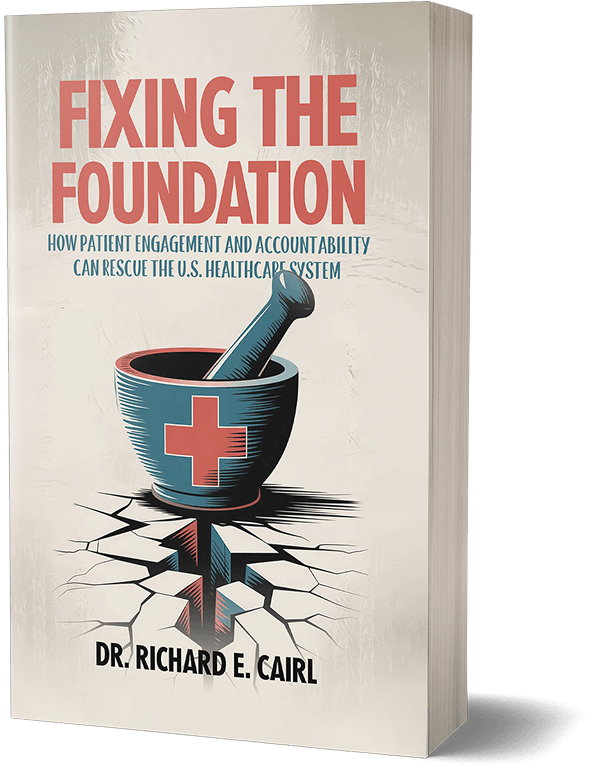
All three questions matter. But in Fixing the Foundation: How Patient Engagement and Accountability Can Rescue the U.S. Healthcare System, Dr. Richard E. Cairl argues that something important has been left out of the conversation: accountability.
More specifically, patient engagement and patient accountability.
Dr. Cairl’s central argument is that healthcare reform cannot succeed if the system continues to focus almost entirely on what institutions, providers, insurers and policymakers do while treating patients mainly as recipients of services. His book calls for patient engagement and accountability to stand alongside access, quality and cost as foundational elements of a sustainable system.
Why does that matter?
Because a large part of health is shaped outside the clinic.
Patients decide whether to take medications, attend appointments, complete screenings, monitor chronic conditions, follow care plans and make everyday lifestyle choices. These decisions influence outcomes just as surely as the quality of a medical procedure or the availability of a specialist.
Yet the system often measures provider performance in great detail while placing far less emphasis on whether patients are being equipped, motivated and expected to take an active role.
That imbalance is especially important in chronic disease.
Conditions such as diabetes, hypertension, cardiovascular disease and obesity require ongoing self-management. A doctor may create a strong treatment plan, but the success of that plan still depends on what happens between visits.
This is where Dr. Cairl’s idea of accountability becomes essential.
Importantly, he does not define accountability as blame. Instead, the book presents it as shared ownership. Patients should be supported with clear information, health literacy, behavioral tools, realistic goals and communication strategies that make participation possible. Providers, in turn, should treat engagement as a core part of clinical work rather than an optional extra. Policymakers should create structures that reward and measure it.
The book also moves beyond theory.
Dr. Cairl explores readiness assessments, motivational interviewing, shared decision-making, behavioral nudges, self-monitoring, digital health tools and AI-driven chatbots as practical ways to strengthen participation. The goal is to move engagement from an abstract value to something measurable and actionable.
That is what makes accountability a potential missing pillar.
Access without engagement may get patients through the door but not necessarily improve what happens afterward. Quality without participation may produce excellent recommendations that are never followed. Cost control without prevention and self-management may simply shift expenses instead of reducing them.
A stronger healthcare system may need all four working together.
Access. Quality. Cost. Accountability.
Fixing the Foundation: How Patient Engagement and Accountability Can Rescue the U.S. Healthcare System challenges readers to rethink reform from the ground up. Dr. Richard E. Cairl’s message is clear: if patients remain peripheral to the system, lasting improvement will remain difficult. But if they are treated as informed, supported and accountable partners, healthcare reform may finally have a stronger foundation.
Read the book on Amazon: https://www.amazon.com/dp/B0GRCRBKB6/